In 1. Forward models in CUQIpy and data generation, we introduced forward models in CUQIpy, here we discuss in some detail two more examples of forward models, a model for the 1D heat conduction problem described by a Poisson problem, and a model for 1D convolution. The latter we already introduced in 1. Forward models in CUQIpy and data generation but we elaborate on it here with more details and exercises. These two models are also used in other sections of the book to demonstrate various concepts in Bayesian inversion.
Table of contents
3.1. Learning objectives
3.2. Forward model: 1D Poisson
3.3. Forward model: 1D convolution
3.1. Learning objectives 
Create (or load pre-existing) linear and non-linear forward models in CUQIpy and use them
Create and plot input for the forward models and compute and plot the corresponding output
Mathematically define two forward models: 1D Poisson and 1D Convolution and use them in CUQIpy
Notebook Cell
from cuqi.testproblem import Poisson1D, Deconvolution1D, Heat1D
from cuqi.distribution import Gaussian
from cuqi.array import CUQIarray
import numpy as np
import matplotlib.pyplot as plt
3.2. Forward model: 1D Poisson 
Here we consider a heat conduction problem for a conductive rod of length with a varying conductivity (the conductivity of the rod changes from point to point). We assume that the rod length is large relative to its thickness and thus can be modeled as a 1D domain, we refer the reader to Kakaç et al. (2018) for further reading on heat conduction. We fix the temperature at the end-points of the rod and apply a heat source distributed along the length of the rod. We wait until the rod reaches an equilibrium temperature distribution. The equilibrium temperature of the rod is modelled using the Poisson equation as
Here, represents the spatial coordinate and represents the temperature distribution along the rod, is the unknown conductivity of the rod and is a deterministic heat source given by
To ensure that the conductivity of the rod is non-negative, we parameterize by the log conductivity as follows:
where is not necessarily positive.
From this point on, we assume and denote the discretized versions of the log conductivity and temperature distribution, respectively, stemming from discretizing the Poisson equation using the finite difference method. Let us load the forward model that maps to the temperature distribution in CUQIpy. We will use the following parameters:
dim: number of equi-spaced discretization points (nodes) on the intervalL: length of the rodf: a function that represents the heat source
dim = 128
L = np.pi
f = lambda xi: 10*np.exp(-(xi-L/2)**2 / 0.02)
Then we can load the 1D Poisson forward model as follows:
A = Poisson1D(dim=dim, endpoint=L, source=f).modelA is a CUQIpy model that maps the log conductivity x to the measurements y via solving the Poisson equation above. We print the forward model to see its details.
ACUQI PDEModel: Continuous1D[128] -> Continuous1D[127].
Forward parameters: ['x'].
PDE: SteadyStateLinearPDE.We can look at the domain and range geometries of the forward model.
print(A.domain_geometry)
print(A.range_geometry)
Continuous1D[128]
Continuous1D[127]
These geometries are of type Continuous1D which represents a 1D continuous signal/field defined on a grid. We can view the 1D grid which is stored as a numpy 1D array:
print(A.domain_geometry.grid)[0. 0.02473695 0.0494739 0.07421085 0.0989478 0.12368475
0.1484217 0.17315865 0.1978956 0.22263255 0.2473695 0.27210645
0.2968434 0.32158035 0.3463173 0.37105425 0.3957912 0.42052815
0.4452651 0.47000205 0.494739 0.51947595 0.5442129 0.56894985
0.5936868 0.61842375 0.6431607 0.66789765 0.6926346 0.71737155
0.7421085 0.76684545 0.7915824 0.81631935 0.8410563 0.86579325
0.8905302 0.91526715 0.9400041 0.96474105 0.989478 1.01421495
1.0389519 1.06368885 1.0884258 1.11316275 1.1378997 1.16263665
1.1873736 1.21211055 1.2368475 1.26158445 1.2863214 1.31105835
1.3357953 1.36053225 1.3852692 1.41000615 1.4347431 1.45948005
1.484217 1.50895395 1.5336909 1.55842785 1.5831648 1.60790175
1.6326387 1.65737565 1.6821126 1.70684955 1.7315865 1.75632345
1.7810604 1.80579735 1.8305343 1.85527125 1.8800082 1.90474515
1.9294821 1.95421905 1.978956 2.00369295 2.0284299 2.05316685
2.0779038 2.10264075 2.1273777 2.15211465 2.1768516 2.20158855
2.2263255 2.25106245 2.2757994 2.30053635 2.3252733 2.35001025
2.3747472 2.39948415 2.4242211 2.44895805 2.473695 2.49843195
2.5231689 2.54790585 2.5726428 2.59737975 2.6221167 2.64685365
2.6715906 2.69632755 2.7210645 2.74580145 2.7705384 2.79527535
2.8200123 2.84474925 2.8694862 2.89422315 2.9189601 2.94369705
2.968434 2.99317095 3.0179079 3.04264485 3.0673818 3.09211875
3.1168557 3.14159265]
Additionally, the properties domain_dim and range_dim of the forward model represent the dimension of the input and output of the forward model, respectively.
print(A.domain_dim)
print(A.range_dim)
128
127
Let us create an array representing a discretized constant conductivity provided at the grid nodes
some_x_array = 20*np.ones(A.domain_dim)We can wrap the array in a CUQIarray object:
some_x = CUQIarray(some_x_array, geometry=A.domain_geometry)Note that we pass geometry=A.domain_geometry to equip the CUQIarray object with the same geometry as the domain geometry of the forward model. This geometry will interpret the values of some_x_array as function values evaluated at grid points.
We can plot the conductivity using the plot method of the CUQIarray object
some_x.plot(marker='|')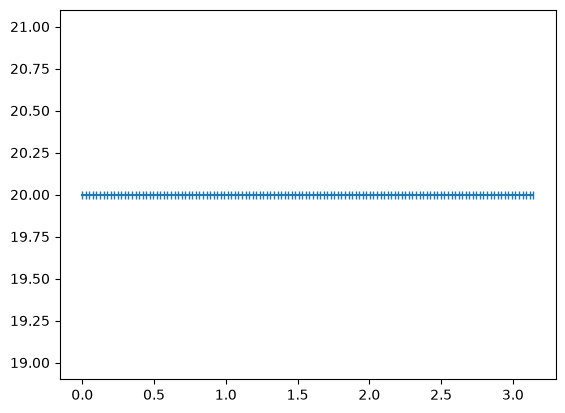
We added the marker '|' for illustration purposes, to show the grid points of the interval [0, L] where the conductivity is evaluated. We can also evaluate the forward model at the conductivity and plot the solution, which is the temperature distribution along the rod as prescribed by the Poisson equation above.
some_y = A(some_x)
some_y.plot()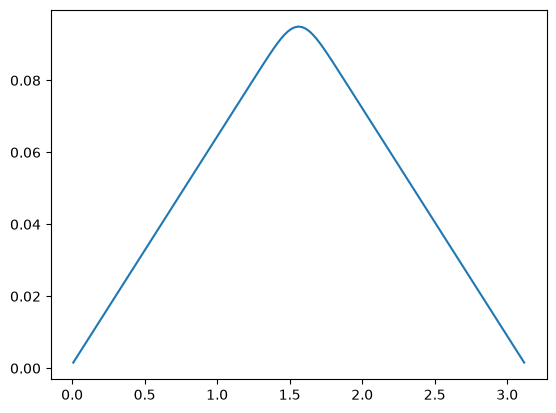
# your code here3.3. Forward model: 1D convolution 
Convolution is a forward model that explains what happens to an input function when it goes through a system where it is convolved with another function that characterizes the system. Convolution arises, e.g., in models for certain measurement systems. Deconvolution is the “opposite”—it arises when we want to determine the input from the output of the system. A convolution of two arbitrary functions and always takes the form
where denotes the output (the convolved signal), is the input signal, and the function describes the system—note that is a function of a single variable. In our example, is a Gaussian function, but it can indeed be any function.
In practice, a finite-dimensional representation of the convolution is employed. After discretizing the signal domain into points, the convolution model is expressed as a system of linear algebraic equations . See Bracewell (1999) for theory about convolution and its relation to the Fourier transform, and see Hansen (2002) for computational aspects of convolution and deconvolution.
Let us load the forward model that maps an input to the convolved signal in CUQIpy. We will use the following parameters to specify the forward model:
dim: is the number of discretization points for the signal,PSF: a function that represents the point spread function, i.e., the convolution kernelPSF_size: the size of the PSF (less or equal todim)PSF_param: A parameter of the PSF, the larger the size the more the blur applied to the signalBC: boundary conditions for the convolution
We set the parameters as follows:
dim = 201
PSF = 'gauss' # Gaussian PSF
PSF_size = np.round(dim/3)
PSF_param = np.round(dim/20)
BC='reflect' # Boundary condition
Then we can load the 1D convolution forward model as follows (note that we refer to the forward model as a convolution model which we obtain from the Deconvolution1D test problem, the latter represents the BIP of deconvolving the signal):
A_deconv = Deconvolution1D(dim=dim, PSF=PSF, PSF_size=PSF_size, PSF_param=PSF_param, BC=BC).modelLet us create a function representing a signal that we want to convolve.
signal_function = lambda xi: (xi>np.round(dim*4/10))*(xi<np.round(dim*6/10))We evaluate the function signal_function at the discretization grid points and wrap it in a CUQIarray object.
signal_array = signal_function(A_deconv.domain_geometry.grid)
signal = CUQIarray(signal_array, geometry=A_deconv.domain_geometry)
Let us plot the signal
signal.plot()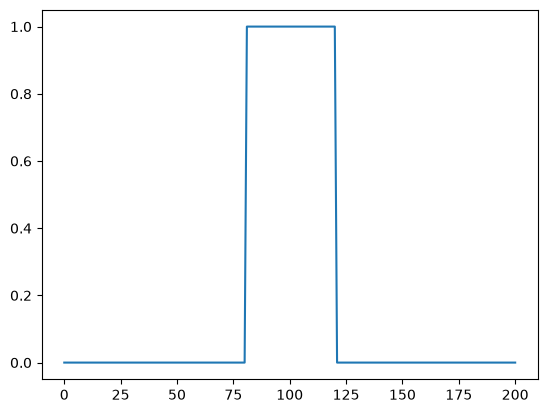
Now, we evaluate the forward model at the signal and plot the output, the convolved signal :
A_deconv(signal).plot()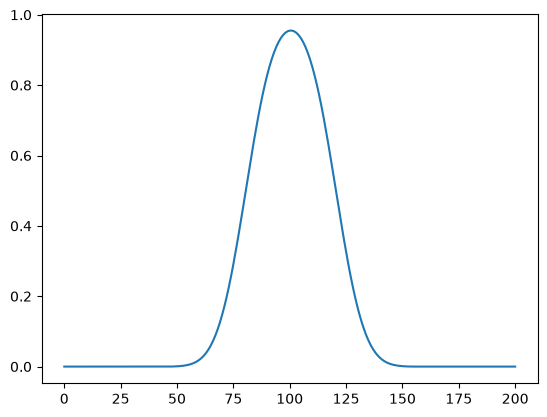
We see that the signal is blurred due to applying the convolution operation (the forward model).
# your code here- Kakaç, S., Yener, Y., & Naveira-Cotta, C. P. (2018). Heat conduction. CRC press.
- Bracewell, R. N. (1999). The Fourier Transform and Its Applications (3rd ed.). McGraw-Hill. https://books.google.com/books?id=ecH2KgAACAAJ
- Hansen, P. C. (2002). Deconvolution and regularization with Toeplitz matrices. Numerical Algorithms, 29(4), 323–378.