Here we define and solve a very simple Bayesian inverse problem (BIP) using CUQIpy. The purpose of this example is to introduce the basic concepts of Bayesian inverse problems in a simple way and to use minimal CUQIpy code to solve it.
In the next section ,2. Probably the simplest BIP in the world (the long story), we discuss more details about setting up this BIP in CUQIpy and provide many exercises to help the reader to explore using CUQIpy in solving BIPs and think of slightly different BIP modeling scenarios.
Table of contents
1.1. Learning objectives
1.2. Defining the BIP
1.3. Solving the BIP
1.4. Summary
1.5. References
1.1. Learning objectives 
Create a simple BIP in CUQIpy
Create a linear forward model object
Create distribution objects that represent the prior, the noise, and the data distributions
Use the
BayesianProblemclass to define the BIP
Solve a simple BIP in CUQIpy
Compute the maximum a posteriori (MAP) estimate
Sample from a simple posterior distribution and visualize the results
1.2. Defining the BIP 
Consider the following inverse problem: given observed data , determine , and :
We can also write it in the following matrix form:
| variable | description | dimension |
|---|---|---|
| parameter to be inferred | 2-dimensional | |
| forward model | 1-by-2 matrix | |
| data | 1-dimensional | |
| noise | 1-dimensional |
This problem is:
A linear inverse problem since the forward model is linear.
Ill-posed (in the sense of Hadamard [1]) since the solution is not unique, i.e., for some given value of , e.g., , all parameter pairs satisfying are solutions to the (noise-free) problem.
Let us define the BIP components and solve the BIP using CUQIpy.
Notebook Cell
# Importing the required libraries
from cuqi.distribution import Gaussian
from cuqi.problem import BayesianProblem
from cuqi.model import LinearModel
from cuqi.utilities import plot_1D_density, plot_2D_density
import numpy as np
import matplotlib.pyplot as plt
np.random.seed(0)
1.2.1. The forward model 
Let us define the forward model . We start by specifying the underlying matrix:
A_matrix = np.array([[1.0, 1.0]])Now we wrap A_matrix in a CUQIpy forward model object, which we name A, as follows:
A = LinearModel(A_matrix)
print(A)
CUQI LinearModel: _DefaultGeometry1D[2] -> _DefaultGeometry1D[1].
Forward parameters: ['x'].
1.2.2. The prior 
Bayesian approach: Use prior to express belief about solution
A common choice for simplicity is the zero mean Gaussian prior where the components are independent and identically distributed (i.i.d.):
The probability density function (PDF) of such a Gaussian prior is expressed as
where:
is the dimension of the parameter space (which is 2 in this specific case),
is the standard deviation of the prior distribution,
is the identity matrix.
Let us specify the prior distribution for the parameter in CUQIpy:
x = Gaussian(np.zeros(2), 2.5)
print(x)
CUQI Gaussian.
We can plot the prior PDF for the parameters and , along with samples from the prior distribution:
# Plot PDF
im = plot_2D_density(x, v1_min=-5, v1_max=5, v2_min=-5, v2_max=5)
plt.colorbar(im, label='Probability Density')

# Sample
x_samples = x.sample(1000)

# Plot samples
x_samples.plot_pair(ax=plt.gca(), scatter_kwargs={'s': 10})
plt.ylim(-5,5);
plt.xlim(-5,5);
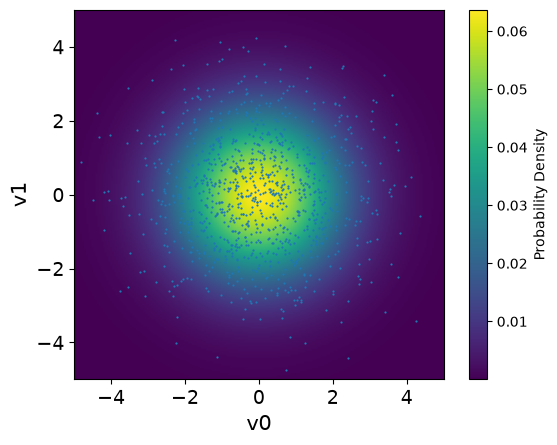
The background of the plot represents the probability density function (PDF) of the prior and the blue dots are the samples from the prior distribution.
1.2.3. The noise distribution 
As mentioned earlier, we assume
We can define the noise distribution as follows:
e = Gaussian(0, 0.1)Let us also plot the PDF of the noise distribution, using the python function plot_pdf_1D:
plot_1D_density(e, -1.5, 1.5)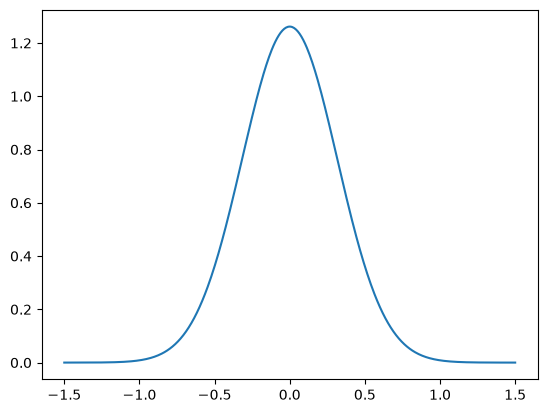
1.2.4. The data distribution 
The noise in the measurement data follows and due to the relation , we can write
and in this case we specify .
The data distribution is the conditional distribution of given .
This PDF can only be evaluated for a given .
We create the data distribution object as follows:
b = Gaussian(A@x, 0.1)
print(b)
CUQI Gaussian. Conditioning variables ['x'].
Before sampling or evaluating the PDF of b, we need to specify the value of the parameter x. Let us choose the following value:
particular_x = np.array([1.5, 1.5])Then we condition the data distribution b on the given parameter particular_x:
b_given_particular_x = b(x=particular_x)
print(b_given_particular_x)
CUQI Gaussian.
Now we have the distribution object b_given_particular_x that represents the data distribution given a particular value of the parameters x. We can now plot the PDF of this distribution:
plot_1D_density(b_given_particular_x, 1.5, 4.5)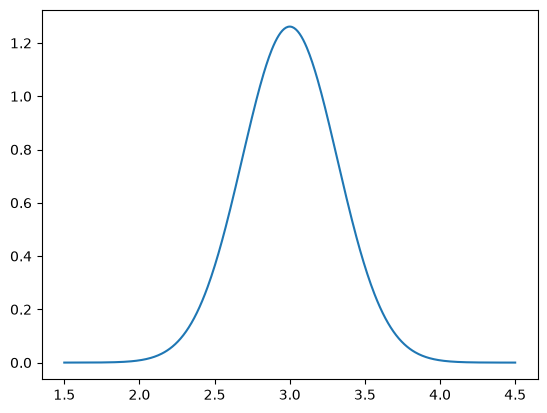
We can use b_given_particular_x to simulate noisy data assuming that the true x parameters is particular_x:
b_obs = b_given_particular_x.sample()
print(b_obs)
2.5152477997936127
If we draw another sample from the data distribution b_given_particular_x, we will get a different noisy data instance as shown below:
b_obs = b_given_particular_x.sample()
print(b_obs)
2.458627499521005
We will use this second instance as the observed data in this BIP.
1.2.5. The likelihood function 
We obtain the likelihood function by fixing observed data in the data distribution and considering the function of :
Since we are using a Gaussian noise model, the likelihood can be formulated as
In CUQIpy, we can define the likelihood function as follows:
likelihood = b(b=b_obs)
print(likelihood)
CUQI Gaussian Likelihood function. Parameters ['x'].
Note that the likelihood function is a density function and is not a distribution. If we try to compute pdf for example, we will get an error.
We plot the likelihood function for the observed data b_obs:
x1_lim = np.array([-5, 5])
x2_lim = np.array([-5, 5])
im = plot_2D_density(
    likelihood,
    v1_min=x1_lim[0], v1_max=x1_lim[1],
    v2_min=x2_lim[0], v2_max=x2_lim[1])
plt.colorbar(im, label='Likelihood')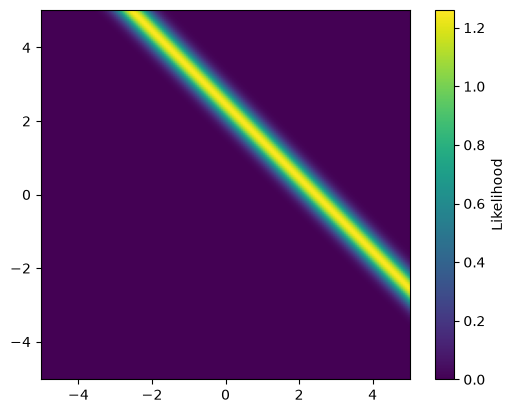
One method of estimating the inverse problem solution is to maximize the likelihood function, which is equivalent to minimizing the negative log-likelihood function. This is known as the maximum likelihood (ML) point estimate.
For this problem, all the points that satisfy are solutions to this maximization problem. These solutions are depicted as the red dashed line in the likelihood plot below.
# Plot the likelihood
im = plot_2D_density(
    likelihood,
    v1_min=x1_lim[0], v1_max=x1_lim[1],
    v2_min=x2_lim[0], v2_max=x2_lim[1])
plt.colorbar(im, label='Likelihood')

# Plot the line x2 = b_obs - x1
plt.plot(x1_lim, b_obs-x1_lim, '--r')
plt.ylim(x2_lim);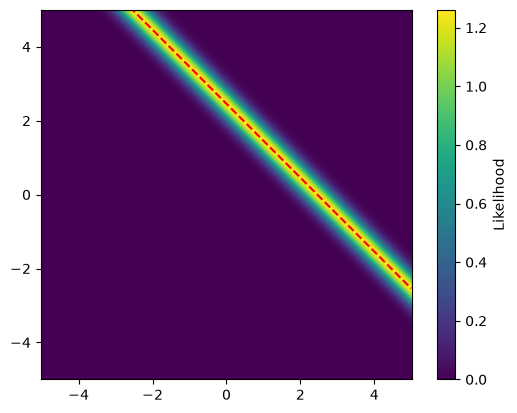
Combining the likelihood with the prior will give us a unique maximum a posteriori (MAP) point estimate as we will see next.
1.2.6. Putting it all together, the BIP 
Posterior definition using the Bayes’ rule
The posterior is proportional to the product of likelihood and prior
In CUQIpy, we can use the class BayesianProblem to bundle the prior, the data distribution, and the data, then use it to explore the posterior distribution (e.g. point estimate and sampling):
BP = BayesianProblem(b, x)
print(BP)
BayesianProblem with target:
JointDistribution(
Equation:
p(b,x) = p(b|x)p(x)
Densities:
b ~ CUQI Gaussian. Conditioning variables ['x'].
x ~ CUQI Gaussian.
)
Now we pass the data:
BP.set_data(b=b_obs)
print(BP)
BayesianProblem with target:
Posterior(
Equation:
p(x|b) ∝ L(x|b)p(x)
Densities:
b ~ CUQI Gaussian Likelihood function. Parameters ['x'].
x ~ CUQI Gaussian.
)
Note the difference in the target of the BayesianProblem object before and after passing the data. In the first case, the target is of type JointDistribution, while in the second case, the target becomes a Posterior object.
1.3. Solving the BIP 
One approach to solve the BIP is to compute a point estimate which is a single solution () that summarizes the posterior distribution. A common point estimate is the maximum a posteriori (MAP) estimate which we compute next. Then we study the posterior distribution by sampling from it and visualizing the results.
1.3.1. Maximum a posteriori (MAP) estimate 
The MAP estimate is defined as the maximizer of the posterior
In the case with Gaussian noise and Gaussian prior, this is the classic Tikhonov solution, see sections 3. Prior information and Bayesian inverse problems and 4. Gaussians priors for more details:
To compute (and print) the MAP estimate in CUQIpy, we write:
map_estimate = BP.MAP()
print(map_estimate)
!!!!!!!!!!!!!!!!!!!!!!!!!!!!!!!!!!!!!!!!!!!!!!!!!!!!!!!!
!!! Automatic solver selection is a work-in-progress !!!
!!! Always validate the computed results. !!!
!!!!!!!!!!!!!!!!!!!!!!!!!!!!!!!!!!!!!!!!!!!!!!!!!!!!!!!!
Using direct MAP of Gaussian posterior. Only works for small-scale problems with dim<=2000.
[1.20520956 1.20520956]
1.3.2. Sampling from the posterior 
The MAP estimate is a very useful point estimate, but it does not provide information about the uncertainty associated with the estimate. To quantify uncertainty in the solution, we can compute posterior variance or other statistics. In this example, we have a closed form expression of the posterior which we can readily compute these statistics from. However, in general, direct computation of such statistics might not be possible or feasible. A more general approach is to use sampling methods to explore the posterior distribution which we illustrate next.
To sample the posterior distribution in CUQIpy, we can use the sample_posterior method of the BayesianProblem object:
samples = BP.sample_posterior(1000)!!!!!!!!!!!!!!!!!!!!!!!!!!!!!!!!!!!!!!!!!!!!!!!!!!!!!!!!!!
!!! Automatic sampler selection is a work-in-progress. !!!
!!! Always validate the computed results. !!!
!!!!!!!!!!!!!!!!!!!!!!!!!!!!!!!!!!!!!!!!!!!!!!!!!!!!!!!!!!
Using direct sampling of Gaussian posterior. Only works for small-scale problems with dim<=2000.
No burn-in needed for direct sampling.
Sample 1000 / 1000
Elapsed time: 0.010293722152709961
We plot the samples over the posterior PDF:
# Plot the posterior PDF
im = plot_2D_density(BP.posterior, x1_lim[0], x1_lim[1], x2_lim[0], x2_lim[1])
plt.colorbar(im, label='Posterior')

# Plot the posterior samples
samples.plot_pair(ax=plt.gca(), scatter_kwargs={'s': 10})
plt.plot(map_estimate[0], map_estimate[1], 'ro')
plt.ylim(x2_lim);
plt.xlim(x1_lim);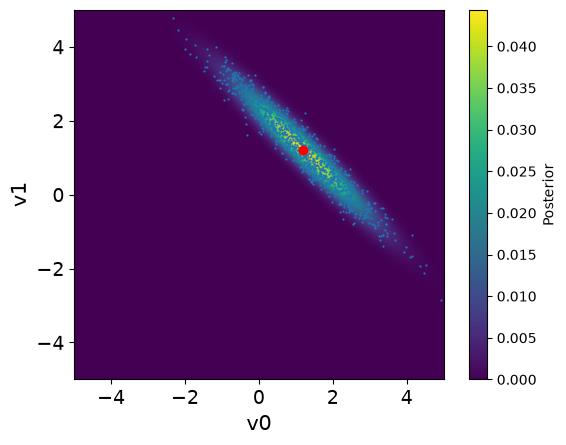
We note that the samples are concentrated over the high probability region of the posterior distribution indicating that the samples are representative of the posterior distribution.
1.4. Summary 
We defined a simple Bayesian inverse problem (BIP) with two unknown parameters and solved it using CUQIpy. We defined the forward model, the prior, and the data distribution; and created simulated data to use it as the BIP observed data. We then combined these components to define the BIP using the BayesianProblem class. We computed the maximum a posteriori (MAP) estimate and sampled from the posterior distribution to quantify the uncertainty in the estimate.
1.5. References 
Latz, J. (2020). On the well-posedness of Bayesian inverse problems. SIAM/ASA Journal on Uncertainty Quantification, 8(1), 451-482.